
Year 5Science
Year 5 Science Exam worksheet: Materials Properties
Year 5 Science exam worksheet exploring Mrs. Smith's pencil case scenario and saucepan material explanation.
Year 5Science
Year 5 Science exam worksheet exploring Mrs. Smith's pencil case scenario and saucepan material explanation.
Subject: Science | Year: 5
Name: _________________________ Class/Set: ____________ Date: ____________
Mark the correct answer.
⇨ Consider the following scenario when answering Q1 and Q2.
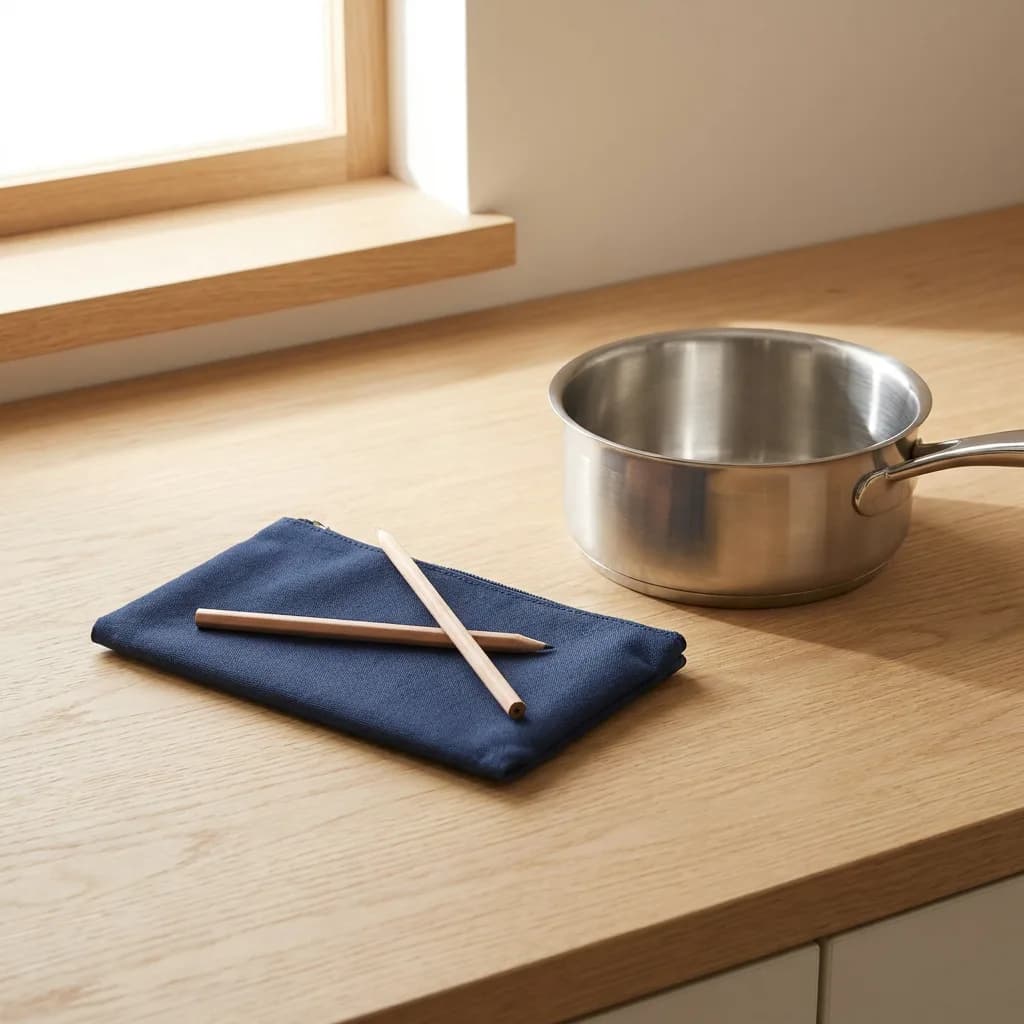
Mrs. Smith wants to make a new pencil case for her art supplies. She needs a material that will protect her pencils and brushes, be easy to carry, and not break if dropped. She is thinking about using either a thin metal sheet, a piece of fabric, or a block of wood.
Q1: Which property of a material describes how easily it can be bent or shaped without breaking? a) ☐ Hardness b) ☐ Durability c) ☐ Flexibility d) ☐ Strength
Q2: If Mrs. Smith wants her pencil case to be soft and easy to fold, which material property is most important for her to consider? a) ☐ Electrical conductivity b) ☐ Flexibility c) ☐ Opacity d) ☐ Brittleness
Q3: Which material is generally the best thermal conductor, meaning it allows heat to pass through it easily? a) ☐ Wood b) ☐ Plastic c) ☐ Metal d) ☐ Fabric
Q4: A material that dissolves when mixed with a liquid is described as being: a) ☐ Insoluble b) ☐ Magnetic c) ☐ Soluble d) ☐ Transparent
Q5: What property makes a material suitable for making windows? a) ☐ Opacity b) ☐ Transparency c) ☐ Absorbency d) ☐ Elasticity
Answer in the spaces provided.
⇨ The following information describes the characteristics of a common kitchen item.
A saucepan is used for cooking food on a hob. It has a main pot, usually made of metal, and a handle, often made of plastic or wood. The metal pot heats up quickly to cook the food, but the handle needs to stay cool enough to touch safely.
Q6: Explain why different materials are used for the main pot and the handle of a saucepan. [4 marks]
Q7: Describe three different properties a material needs to have to be suitable for making a waterproof raincoat. For each property, explain why it is important. [6 marks]
Total Marks: _______
Q1: c
Explanation: Flexibility is the ability of a material to bend without breaking. Hardness is resistance to scratching, durability is long-lasting, and strength is resistance to breaking under force.
Q2: b
Explanation: For a soft, foldable pencil case, flexibility is key. Electrical conductivity relates to electricity, opacity means not see-through, and brittleness means it breaks easily.
Q3: c
Explanation: Metals are excellent thermal conductors, allowing heat to transfer efficiently for cooking. Wood, plastic, and fabric are generally poor thermal conductors (insulators).
Q4: c
Explanation: A material is soluble if it can dissolve in a liquid. Insoluble materials do not dissolve. Magnetic materials are attracted to magnets, and transparent materials allow light to pass through.
Q5: b
Explanation: Transparency allows light to pass through, enabling people to see through windows. Opacity blocks light, absorbency soaks up liquid, and elasticity allows stretching and returning to original shape.
Effectively diagnosing pupils' understanding of scientific concepts often presents a challenge, requiring nuanced assessment design. The multi-choice section, particularly Q1 regarding flexibility for Mrs. Smith's pencil case, immediately identifies foundational knowledge gaps. This gradient assessment structure, progressing from low-stakes recall to high-stakes application in Section B's saucepan explanation, strategically reduces intrinsic cognitive load. It thereby fosters confidence while simultaneously demanding the deeper reasoning and justification crucial for Year 5's transition to independent scientific inquiry, ensuring a valid and reliable measure of materials properties comprehension.
Join thousands of educators in England who are saving hours every week with MagiTeacher.
Try MagiTeacher for Free